Buying a waterfront home in Manchester can feel like a dream come true, but the view is only part of the story. If you are drawn to shoreline living, you also need to understand permits, setbacks, flood questions, and the condition of systems that may not get much attention during a casual showing. The good news is that a little upfront due diligence can help you buy with more confidence and fewer surprises after closing. Let’s dive in.
Manchester waterfront homes need extra due diligence
In Manchester, a waterfront or view property is not just a lifestyle purchase. It is also a property type where lot conditions, shoreline rules, slope issues, and view-related limits can matter just as much as the house itself.
Kitsap County notes that development within 200 feet of the ordinary high-water mark can trigger shoreline review. On top of that, shoreline parcels have a Shoreline Environment Designation that can affect the required buffer, and when more than one rule applies, the greatest setback can control.
That means a home that looks simple on paper may come with real limits on future changes. If you hope to add square footage, rebuild a deck, move stairs, clear trees, or make shoreline improvements later, you will want to understand those constraints before you buy.
Shoreline setbacks can shape your options
One of the first things to check is where the usable building area actually sits on the lot. Waterfront parcels can have shoreline setbacks, buffers, steep-slope concerns, and irregular lot geometry that reduce what you can build or change.
Kitsap County also cautions that critical-area mapping is not a substitute for a survey or field review. In plain terms, online map colors are a starting point, not a final answer.
If you are evaluating a Manchester waterfront home, it is smart to verify the actual shoreline, slope, and buffer lines rather than assume the lot works the way it appears from a listing photo or tax map. This matters even more if you are counting on future improvements.
Manchester view rules matter too
Manchester also has a view protection overlay. According to Kitsap County, that overlay can affect building height and view blockage, with exceptions only in narrow circumstances.
This is especially important if you are buying a view home rather than true waterfront. You may be thinking about adding another story, changing the roofline, or expanding upward later, but local rules may limit those plans.
It is also relevant if nearby development could affect what you see from the property. A good purchase decision includes understanding how the overlay applies to the home you are considering and what that could mean for future changes.
Tree removal and grading are not simple DIY projects
A lot of buyers look at a waterfront lot and immediately think about trimming trees, improving the view, or reworking the yard. In shoreline areas, those steps can require more review than many people expect.
Kitsap County warns against removing trees or starting clearing and grading before checking with the Department of Community Development. Those actions can require separate permits or reviews, especially near shoreline or steep-slope areas.
If view improvement is part of your plan, ask early what is allowed. That can save you from buying a home based on assumptions that do not hold up once you begin work.
Bulkheads, docks, and stairs deserve close review
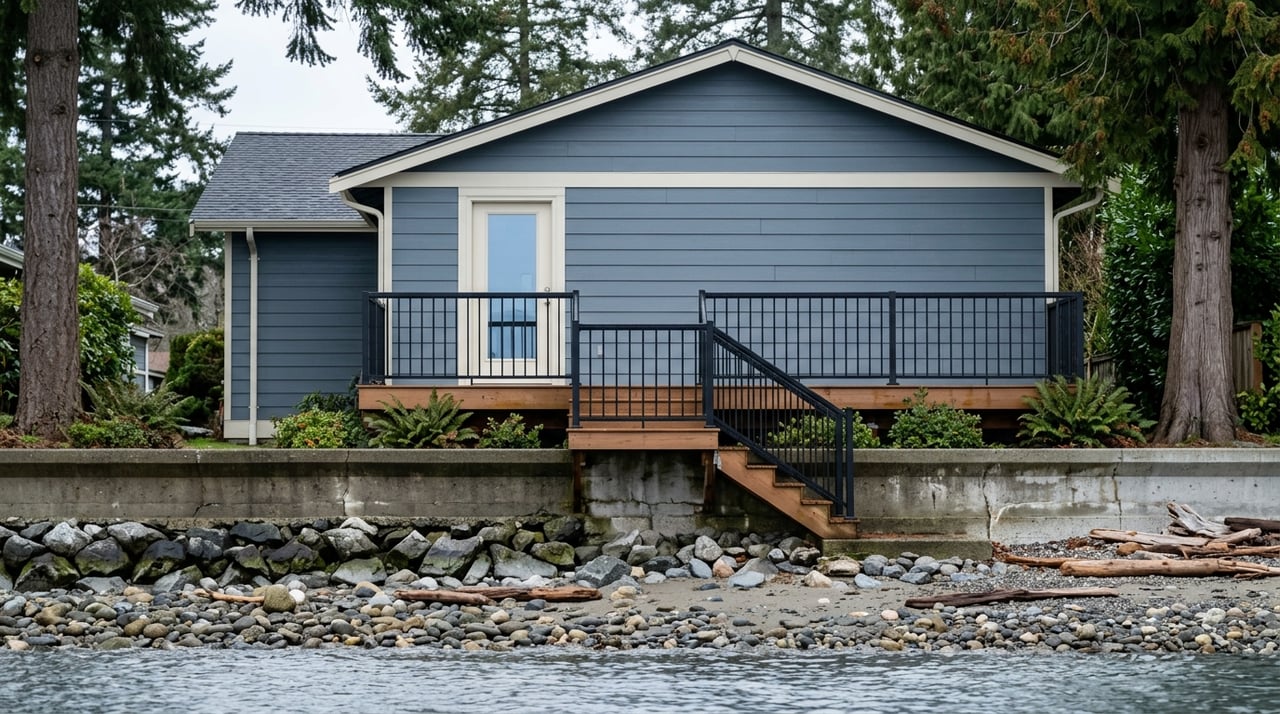
Shoreline improvements can be some of the most expensive and heavily regulated parts of a waterfront property. If the home has a bulkhead, dock, beach stairs, or evidence of shoreline grading, those features deserve careful review during your inspection period.
Kitsap County says a normal protective bulkhead for a single-family residence may be exempt from a Shoreline Substantial Development Permit if strict criteria are met. But that does not mean no permit is needed at all, and exemptions are not automatic.
The county also makes clear that if any part of a project does not qualify for exemption, the whole project may need a Shoreline Substantial Development Permit. That can affect repair timelines, future costs, and what you are allowed to replace.
Questions to ask about shoreline structures
Before you move forward, ask for documentation on any existing shoreline improvements. A few targeted questions can tell you a lot:
- Were the bulkhead, dock, stairs, or shoreline grading ever permitted?
- Is there an exemption letter, permit record, or as-built documentation?
- Has any structure been repaired, replaced, or expanded?
- Could future repair or replacement trigger new shoreline review?
- Are there known issues with erosion, bluff stability, or drainage?
These are practical questions, not small details. The answers can shape both your ownership costs and your future flexibility.
Soft shoreline approaches may matter more than you think
If shoreline stabilization is part of the property’s future, it helps to know that hard armoring is not always the first choice. Kitsap County’s guidance says soft armoring may be a better fit in some cases, can support wildlife, and is often easier to permit.
The county also advises engaging a qualified professional or consultant early for shoreline armoring projects. For buyers, that is a useful signal that these are specialized decisions, not routine handyman work.
For bluff or shore protection proposals, Kitsap may require information on existing structures, alternatives to hard approaches, habitat impacts, vegetation removal and revegetation, erosion timing, the ordinary high-water mark, and tideland or bedland ownership. That is another reason to treat a Manchester waterfront purchase as a team effort.
Dock maintenance can trigger more review
A private dock can be a major lifestyle benefit, but it also comes with rules. Kitsap treats a single-family dock as a water-dependent use, yet the county restricts some materials and maintenance practices in the water.
Substantial maintenance or replacement work can also trigger additional application requirements. So if a dock looks worn, do not assume it will be simple to rebuild with the same footprint and materials.
If the property includes over-water improvements, ask not only whether they exist, but also how old they are, how they have been maintained, and what approvals may be needed for future work.
Flood insurance should be part of your budget planning
Waterfront buyers should also review flood risk early. The Washington Office of the Insurance Commissioner says standard home policies usually do not cover flood damage, so a separate flood policy may be needed.
If a property is in a Special Flood Hazard Area, your mortgage may require flood insurance. The same state guidance notes that NFIP coverage usually starts 30 days after the policy is written unless the policy is required for the mortgage.
This matters for both cost and timing. You do not want to learn late in the transaction that required coverage changes your monthly payment or closing timeline.
What to ask your insurance carrier
When you are getting quotes, ask direct questions so you understand the real cost of ownership:
- Is the property in a flood zone or Special Flood Hazard Area?
- What are the building and contents coverage limits?
- What deductible options are available?
- Is replacement-cost coverage available?
- Does the policy cover sewer backup, or would that require an endorsement?
- Are accessory shoreline structures covered separately?
- Is there a waiting period before coverage begins?
You can also use FEMA’s Flood Map Service Center to confirm flood hazard information such as flood zone, base flood elevation, and floodway status.
Septic and water reviews are essential in Kitsap
Not every major risk on a waterfront property is visible from the shoreline. In Kitsap County, septic and water system status should be part of your due diligence before closing.
Kitsap Public Health says buyers and sellers should know the status of septic systems before a sale closes and that a property conveyance inspection can be requested. In 2025, 27 percent of septic conveyance inspections found significant deficiencies.
That is a strong reminder not to treat septic as a box to check at the last minute. Repairs can be expensive, and system condition can affect how confidently you move forward.
If the property is served by a private or Group B water system, Kitsap Public Health says a Water Status Report is required before sale. Be sure you understand what water source serves the home and whether the required documentation is already available.
Permit history can reveal future headaches
When buying a Manchester waterfront home, permit history often tells an important story. It can show whether additions, decks, stairs, shoreline work, or other changes were reviewed properly and whether final approvals were completed.
Kitsap County handles permit applications through its Permit Application Portal and manages them through the Online Permit Center. Reviewing the property’s permit trail can help you spot gaps before they become your problem.
This is especially important when a property has had visible updates near the shoreline or on sloped ground. Missing records do not always mean something is wrong, but they do mean you should ask more questions.
Ongoing maintenance looks different on the shoreline
Owning a waterfront home often means a more active maintenance plan than owning an inland property. Drainage, vegetation, erosion, and shoreline conditions all need regular attention.
Kitsap’s guidance recommends managing water and plants, using native erosion-resistant vegetation, leaving drift logs where appropriate, and setting homes back from the water when possible. The broader point is that working with natural shoreline conditions can sometimes be more effective than jumping straight to hard fixes.
That can influence both your budget and your vendor needs over time. If you are buying partly as an investment or future rental, it is worth thinking through the operational side of ownership as well as the purchase itself.
A smart waterfront purchase is a team process
The strongest approach to buying a waterfront home in Manchester is to treat due diligence as a multi-party process. Depending on the property, that can include county shoreline review, septic and water review through public health, flood-map and insurance review, and specialist input for shoreline armoring or bluff work.
That may sound like a lot, but it is often what protects your outcome. The goal is not to make the purchase harder. The goal is to help you understand what you are buying, what it may cost to maintain, and what changes may or may not be possible later.
If you are considering a waterfront or view property in Manchester, working with a local brokerage that understands Kitsap’s micro-markets, permits, and property conditions can make the process much smoother. When you are ready to talk through the pros, tradeoffs, and next steps, connect with Christopher Threet | Greater Peninsula Properties.
FAQs
What should you verify before buying a waterfront home in Manchester?
- You should verify shoreline setbacks, slope or buffer constraints, permit history, flood-zone status, insurance options, septic condition, water-system status, and any records for bulkheads, docks, stairs, or shoreline grading.
How do shoreline rules affect Manchester waterfront properties?
- In Kitsap County, development within 200 feet of the ordinary high-water mark can trigger shoreline review, and overlapping rules may require the greatest setback to apply.
Does Manchester have rules that protect views?
- Yes. Manchester has a view protection overlay that can affect building height and view blockage, which can matter if you want to expand or change a home later.
Are bulkheads and docks automatically allowed on Manchester waterfront lots?
- No. Some projects may qualify for exemptions under strict criteria, but exemptions are not automatic and other permits or reviews may still be required.
Do standard homeowners insurance policies cover flood damage in Washington?
- Usually not. The Washington Office of the Insurance Commissioner says flood damage is typically not covered by standard home policies, so you may need separate flood insurance.
Why should septic and water systems be reviewed before closing in Kitsap County?
- Septic and water issues can be costly and are not always obvious during a showing, and Kitsap Public Health says septic status should be known before sale while some private or Group B water systems require a Water Status Report before closing.