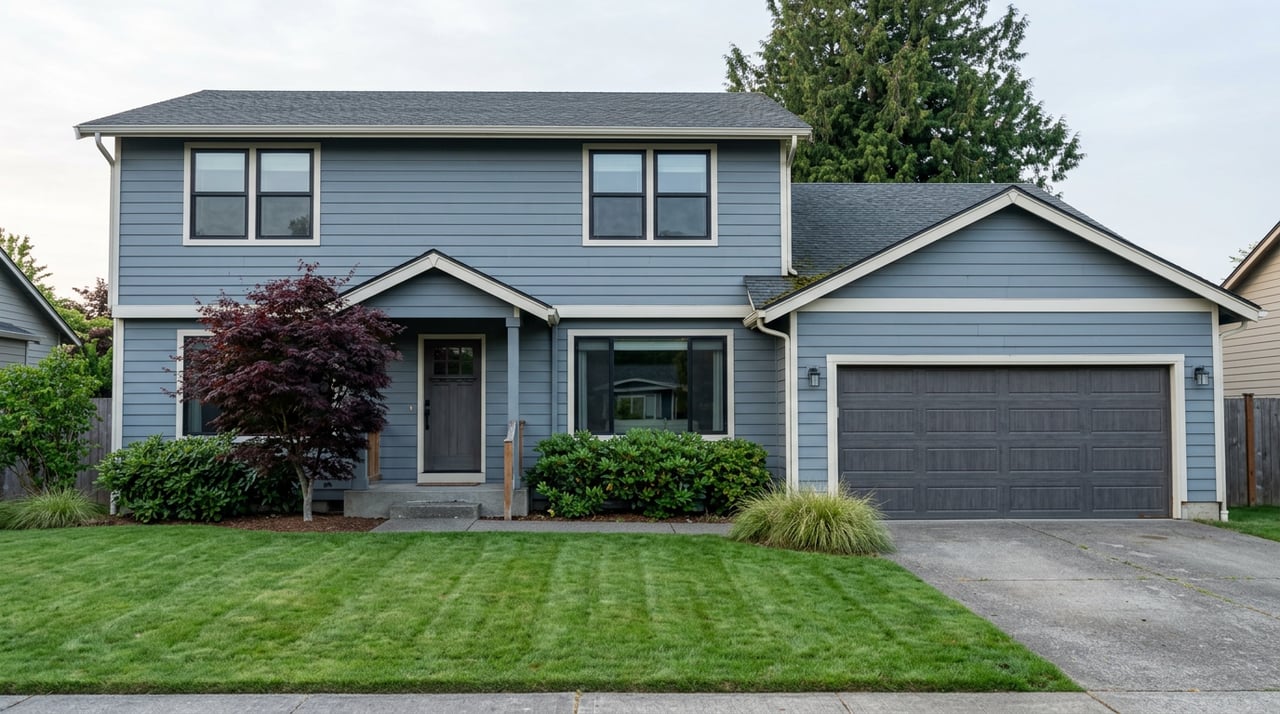
A buyer moving from Seattle spent July reading the same headlines everyone else did. Inventory up nearly 20 percent across Western Washington. Prices softening. Sellers losing leverage. So she walked into Silverdale expecting room to negotiate.
She got two competing offers on the first house she liked and a pending sign within ten days.
That gap between what the regional coverage says and what actually happens on a Silverdale offer deadline is the whole story. The numbers aren't contradictory. They're describing two different markets that happen to share a state line, and Kitsap County sits on the tighter side of that split even while every headline about Western Washington describes the opposite.
What the regional story actually says
The Northwest Multiple Listing Service's July 2026 snapshot is the source most of that coverage is built on, and it does show real loosening. Active listings across the NWMLS service area hit 24,888 by the end of July, a 19.8 percent jump from the same point in 2025. Sellers added 11,517 new listings during the month, up 10.5 percent year over year. The service-area median sale price came in at $640,000, down 1.5 percent from $650,000 a year earlier. Closed sales dipped 3.2 percent.
Steven Bourassa, who directs the Washington Center for Real Estate Research, framed it plainly in the NWMLS release: inventory is climbing faster than transactions are, and mortgage rates sitting above 6.5 percent through July are part of why buyers aren't absorbing the new supply as fast as sellers are listing it.
That's a real trend. It's also a 27-county average, and averages hide the county that's moving the opposite direction.
The line buried in the same report
Inside that same July snapshot, NWMLS ranked every county in its service area by months of inventory. A balanced market runs four to six months of supply. Kitsap County posted 2.28, the lowest of all 27 counties tracked, tighter than Snohomish (3.01), Pierce (3.04), Thurston (3.11), and Clallam (3.23).
So while the region as a whole is drifting toward balance, Kitsap is drifting the other way. That's not a rounding difference. It means a buyer who read the regional headline and assumed Kitsap would follow the same script is working from the wrong script entirely.
What that looks like inside Silverdale specifically
Silverdale's own numbers back up why Kitsap is the outlier. Redfin's tracking puts Silverdale's competitiveness score at 91 out of 100, in the "most competitive" tier the platform uses. Homes there were receiving about two offers on average and going pending in around 10 days over the three months ending May 2026, the most recent window Redfin had published for the city.
Here's the part that actually matters for anyone comparing neighborhoods rather than just glancing at a headline number: the median sale price over that same three-month window was $575,000, down just under 1 percent from the same period a year earlier, while the median price per square foot fell 12 percent over the same stretch.
Those two numbers moving in different directions is a mix-shift signal, not a value signal. It doesn't mean homes in Silverdale are worth 12 percent less than they were a year ago. It means the mix of homes that sold has shifted, likely toward larger or differently priced properties than the year before, which changes the price-per-square-foot math without changing what any single comparable home would fetch. A buyer using price-per-square-foot as a shorthand for "is this a deal" needs to know that shorthand is currently unreliable in Silverdale. The number worth watching is what similar homes on similar lots have actually closed for in the last 60 to 90 days, not the blended average across every square foot that sold.
Regional trend vs. Silverdale reality
| Measure | NWMLS service area (July 2026) | Kitsap County (July 2026) | Silverdale (3 months ending May 2026) |
|---|---|---|---|
| Months of inventory | 3.74 | 2.28 (lowest of 27 counties) | Most competitive tier per Redfin |
| Active listings, YoY | +19.8% | Data not broken out by NWMLS | N/A |
| Median sale price, YoY | -1.5% ($640K) | Data not broken out by NWMLS | -0.92% ($575K) |
| Days on market | N/A | N/A | ~10 days |
| Price per square foot, YoY | N/A | N/A | -12.0% |
The takeaway isn't that Silverdale is immune to the broader slowdown. It's that the slowdown hasn't reached it in the same way, and treating a regional headline or a national portal's trend line as a stand-in for what's happening on a specific Silverdale block will lead a buyer to misjudge how much room they actually have to negotiate.
Why Silverdale might stay tight longer than its neighbors
Part of the answer is what's planned for the ground under it. Kitsap County's comprehensive plan designates the Silverdale Urban Growth Area as a Regional Growth Center under the Puget Sound Regional Council's framework, meaning the county is actively channeling job and population growth into it rather than spreading it evenly across the peninsula. The county's own 2044 planning horizon targets roughly 11,416 new jobs and 9,896 new residents inside that growth area over the next two decades.
The commercial core is changing to match. Kitsap Mall's design district plan calls for the mall to expand into a mixed-use center, tying its pedestrian concourse directly into Silverdale Way, Kitsap Mall Boulevard, and Randall Way NW, with commercial leasing materials already marketing pad sites nearby for multifamily and hotel development. That's a different trajectory than a town like Manchester or Port Orchard, where growth pressure and zoning conversations look different. It doesn't guarantee Silverdale prices keep climbing, but it does mean the county is actively building toward more density, not less, in exactly the corridor most of Silverdale's home inventory sits around.
For a buyer weighing Silverdale against a quieter, more static Kitsap town, that's the forward-looking piece the headline price comparison won't show. A tight market backed by a growth-center designation behaves differently over five years than a tight market that's tight simply because nothing is for sale.
What this means if you're comparing towns right now
If you're cross-shopping Silverdale against Bremerton, Port Orchard, or Gig Harbor, the county-level inventory gap is the number to anchor on, not the regional trend line. Kitsap's 2.28 months of supply as of July 2026 tells you sellers here still hold more leverage than the "buyers gaining ground" narrative suggests, and Silverdale's own 10-day median and multiple-offer pattern back that up at the neighborhood level.
If you're already under contract or about to make an offer, the price-per-square-foot swing is the one to watch closely with your agent rather than trusting a portal's blended average. Ask for the actual closed comps on homes similar in size, condition, and lot to the one you're bidding on. That comparison will tell you more about your real negotiating room than any countywide percentage.
A few questions buyers ask about this
Is Silverdale currently a buyer's market or a seller's market? Based on Kitsap County's 2.28 months of inventory as of July 2026 and Silverdale's own competitiveness data for the three months ending May 2026, it leans toward sellers. A 91 out of 100 competitiveness score, homes averaging around 10 days on market, and multiple offers being common all point to conditions that still favor sellers, even as the broader NWMLS service area shows signs of loosening.
Why do different sites report different median prices for the same area? Median and average are calculated differently, and the geography each site uses to define "Silverdale" can vary too, sometimes matching city limits and sometimes matching a wider zip code. When comparing numbers across sites, check whether you're looking at the same boundary and the same time window before assuming one figure has replaced another.
Does the falling price-per-square-foot mean home values are dropping? Not necessarily. It's a signal that the mix of homes selling has shifted, not proof that any individual home lost value. The closed comps for a specific size and condition of home are a better gauge of actual value than a blended per-square-foot average.
If you're trying to figure out what any of this means for a specific address, or what your own Silverdale home would fetch in the current comp set, Christopher Threet | Greater Peninsula Properties can walk you through the real numbers for your street, not just the county average. Search Homes to see what's actually moving right now.